


SUMMARY
Banks and other financial institutions can track website visitor behavior effectively while maintaining customer trust by using privacy-first web analytics platforms with server-side tracking, automatic PII detection, and data residency controls. The key is separating public website analytics from authenticated digital banking portal tracking, collecting only necessary data, and ensuring full compliance with GLBA, GDPR, and banking regulations from the start.
Financial institutions face a critical challenge: understanding customer behavior online while maintaining the strict privacy standards their clients demand. A single data breach or privacy misstep can erode decades of trust. However, without analytics, banks operate blindly, missing opportunities to improve digital experiences and detect fraud.
Banks and financial institutions rely on data to understand how customers use digital channels, identify friction points and optimize marketing investments. But when every click or conversion may involve sensitive information, analytics in financial services becomes a balancing act between data-driven performance and customer trust.
You don’t have to choose between insights and trust – modern banking analytics can deliver both when implemented correctly. This article explores best practices and recommended steps for banking website analytics, as well as ways to avoid common pitfalls to ensure compliance without sacrificing the quality of insights.
Why traditional analytics falls short for banks
Financial services organizations operate under some of the strictest data protection regulations. This means that marketing and analytics teams in banking often find themselves caught between two pressures:
- Marketing needs accurate attribution and optimization data.
- Legal must ensure responsible data handling and compliance with relevant regulations.
Most banks rely on tools designed for ecommerce and media, not for financial services and online banking platforms that handle sensitive financial information. These tools create several problems:
- Regulatory compliance gaps – Generic analytics tools often can’t meet the requirements of GLBA, GDPR, DORA, state privacy laws and PCI DSS, potentially exposing your institution to fines and legal liability.
- Customer trust erosion – When customers see “allow all cookies” banners on their banking website, they question whether their financial institution truly prioritizes privacy. Recent surveys indicate that 75% of consumers would consider switching banks due to inadequate fraud protection measures.
- Data ownership issues – Third-party analytics providers often claim ownership rights to your customer data, using it to build profiles across the web or share with advertising networks. This means your competitive intelligence and customer insights may be feeding someone else’s business model.
- Lack of data residency control – Many conventional platforms store data across multiple countries and data centers, making it difficult to comply with data localization requirements.
- Cross-domain tracking limitations – Traditional cookie-based tracking breaks when customers move between your marketing site, application portal, and authenticated banking interface, resulting in a fragmented customer journey.
Piwik PRO provides an analytics platform designed specifically for organizations handling sensitive data and subject to strict regulatory requirements. It combines built-in compliance controls and complete data ownership with access to real-time visitor insights and analytics, enabling effective site and campaign optimization. See how it works in action by signing up for a free trial.
How can banking organizations benefit from privacy-first analytics
Privacy-first analytics gives banks a competitive advantage rather than a compliance headache by delivering:
- Higher consent rates and increased customer trust.
- Better data quality and accuracy.
- Reduced risk of regulatory fines and reputational damage.
- Fewer customer service inquiries about data practices.
Effective banking website analytics serves multiple stakeholders within your organization.
Digital and product teams can track conversion funnels for loan applications, account openings, and credit card signups. This helps them identify where customers abandon processes and optimize the user experience across devices and channels.
Marketing teams can understand which campaigns drive valuable customer actions. This helps them attribute conversions accurately and personalize experiences without violating privacy regulations.
Compliance officers can maintain audit trails and automatically enforce data retention policies to ensure GDPR and GLBA-compliant analytics. This helps them demonstrate regulatory compliance with built-in privacy controls.

Learn more about using analytics in banking: Unlocking the potential of digital analytics in finance and banking
Website metrics that actually matter for banks
Instead of tracking generic web metrics, focus on measurements specific to banking analytics and financial institution websites:
Visitor intent and engagement
- Product research patterns – Which product pages do visitors view together? For example, viewing both personal and business checking suggests a small business owner.
- Calculator and tool usage – Mortgage calculator usage predicts loan applications, while retirement planner usage indicates interest in wealth management.
- Content depth on educational pages – Time spent on financial education articles reveals which topics resonate.
- Rate comparison behavior – Do visitors compare savings account rates, loan terms, or investment product returns? This reveals shopping behavior.
Website conversion paths
- Page sequences before applications – What do visitors view immediately before starting an application?
- Cross-session research patterns – How many website visits occur before someone applies for a mortgage?
- Landing page performance by product – Which pages convert browsers into applicants?
- Internal search queries – What are visitors looking for on your site that they can’t easily find?
Application funnel performance
- Drop-off points in web forms – The exact page where visitors abandon applications – for example, income verification or document upload.
- Field-level error rates – Which form fields cause the most validation errors on your website forms?
- Time spent per application step – Longer times on specific pages signal confusion or technical problems.
- Completion rates by traffic source – Do organic search visitors complete applications more than paid ad traffic?
Technical website health
- Page load times by device – Are your product pages slow on mobile?
- Browser-specific errors – Are certain browsers breaking your application forms?
- Broken internal links – Which navigation paths fail?
- Failed form submissions – How often do website forms fail to submit?
Security on a public website
- Bot traffic on forms – Automated attempts to scrape rates or test stolen credentials.
- Unusual traffic spikes – Sudden increases in login page traffic might indicate attacks.
- Geographic anomalies in traffic – Unexpected traffic patterns from specific regions.
- Suspicious form interaction patterns – Bots fill forms much faster than humans.
What to track on different website sections
Different parts of your banking website require different analytics approaches:
Homepage and product pages:
- Track visitor flow and navigation patterns
- Monitor time on page and scroll depth on long pages
- Measure CTA click rates
- Understand how visitors explore your offerings
Rate and comparison pages:
- Monitor which products visitors compare
- Track time spent comparing options
- Measure filtering tool usage
- Identify traffic sources that drive rate shoppers
Educational content and blog:
- Measure content engagement depth
- Track which articles lead to product page visits
- Identify search terms bringing visitors to content
- Monitor content that reduces support inquiries
Application forms:
- Track form start rates and field completion rates
- Monitor error messages triggered
- Measure time per form step
- Identify abandonment points
- Compare completion rates by traffic source
Branch and ATM locators:
- Monitor search patterns (zip code vs map browsing)
- Compare mobile vs desktop usage
- Track whether locator users visit branches
- Measure integration with application flows
Online banking login area:
- Minimize tracking to focus on performance
- Monitor login success rates
- Track page load times and error frequency
- Flag failed authentication attempts for security
- Avoid behavioral tracking once authenticated
Banking website optimization: How to improve your website with analytics for financial services
Website analytics only matters if it drives improvements. Here’s what works when it comes to improving digital banking experiences:
Optimize application forms
Website forms are where visitors become customers. Track each field’s drop-off rate to identify how you can help users navigate through the form and optimize conversion rates. If the employer name field generates 30% errors, add autocomplete. If 40% abandon the form at the income verification stage, simplify the screen or add context about why you need this information.
Fix the mobile website experience
Most banking website traffic comes from mobile devices, yet many bank sites were designed for desktop use. Track mobile-specific issues: forms requiring too much typing, buttons too small for touch or slow load times on cellular. If mobile conversion rates are lower than desktop, your mobile website may need optimization.
Improve site navigation based on visitor paths
If visitors consistently end up in the wrong section while looking for something, your navigation is confusing. Track internal search queries to identify gaps. If people frequently search for “IBAN” or “branch hours,” make this information easier to find.
Reduce page load times
Every second of load time costs conversions. Track which pages are slowest, prioritize fixing high-traffic pages, and monitor performance by device and geography. Aim for under 2 seconds on mobile.
Make content more findable
Use analytics to identify your most valuable content, then promote it better. If your first-time homebuyer guide drives mortgage applications, feature it prominently on your mortgage pages.
Test website changes before full rollout
Use A/B testing for significant changes to landing pages, form layouts, navigation structures, or CTAs. Test it strategically – run one or two high-impact tests at a time, rather than testing everything everywhere all at once.
Create better personalization
Show mortgage content to visitors who used the mortgage calculator. Display business banking options to visitors researching business accounts. Use on-site behavior to make the website experience more relevant without invasive tracking.
Leverage anonymous tracking
Use anonymous tracking to collect analytics without personal data for visitors who don’t consent or ignore consent banners, enabling access to valuable data without breaching customer trust. This allows you to track behavior patterns, page views, and conversions within a single session without identifying individuals across visits.
Learn more about improving the customer journey in banking: How web and product analytics improve the customer journey in banking
What makes banking website analytics different
Banking industry websites and financial sector platforms operate under completely different constraints than standard website analytics approaches. These differences fundamentally change how you should approach bank website tracking:
- Visitors have higher privacy expectations. People tolerate invasive tracking on retail sites but scrutinize their bank’s website more closely. A consent banner on a financial services site that asks visitors to “share data with 500+ partners” destroys trust before they even see your products.
- Banking application abandonment is expensive. An abandoned mortgage application costs significantly more in marketing spend than an abandoned shopping cart, which means that your ROI on banking website conversion optimization is significantly higher.
- Banking forms are make-or-break. Unlike ecommerce, where checkout is simple, banking applications require extensive forms. Form analytics – field-level errors, completion time per step, and abandonment points – is critical for website optimization.
- Rate shopping behavior is unique to financial services. Visitors compare savings rates across different terms, mortgage rates across products, and loan interest rates across tiers. This comparison behavior doesn’t exist in typical ecommerce and requires specialized website tracking.
Common website analytics mistakes
Even with the right analytics platform, banks frequently make avoidable mistakes that undermine data quality and waste resources. Here are some mistakes you should watch out for:
- Tracking every page element “just in case.” Over-collection creates privacy risks. Track banking website interactions that answer specific business questions, nothing more.
- Treating the mobile website as a filtered desktop report. Mobile visitors have different needs, tolerance for friction and conversion patterns. Analyze mobile website behavior separately.
- Ignoring data quality. Bot traffic, internal employee sessions, and test submissions corrupt your insights. Filter these from day one.
- Not connecting analytics to action. Looking at reports doesn’t improve your site. Create processes: conduct weekly website performance reviews with action items, implement automatic alerts for critical issues, and establish monthly optimization priorities based on data.
- Optimizing for page views instead of outcomes. More blog traffic is meaningless if it doesn’t lead to applications. Focus on optimizing metrics that matter: application starts, completion rates, and qualified leads.
How Piwik PRO handles banking website analytics
Piwik PRO Analytics Suite was designed for regulated industries where privacy compliance and data control are critical. The platform enables privacy-compliant web tracking for financial institutions and provides access to valuable banking website analytics insights:
Here are the key features that help financial services organizations achieve better analytics results:
- Complete and accurate data. Get 4x more data thanks to anonymous tracking, gain better visibility into your ad performance, and attribute conversions to the right channels.
- Actionable insights. Use integrations with A/B testing tools, heatmaps, and customer journey mapping with unsampled data to understand actual visitor behavior. Connect insights to the Data Activation module for targeted campaigns.
- Real-time visibility. Monitor current banking website visitor activity, conversion rates, and traffic patterns as they happen with configurable dashboards that track the metrics your team needs daily.
- Integrated first-party data. Connect website analytics with other systems through Data Activation to segment visitors and activate audiences across marketing channels while keeping teams aligned on consistent data.
- Server-side tracking. Route analytics through your own servers rather than the browser using our third-party integrations. Get complete visitor data and full control over data collection and processing.
- Cross-platform tracking. Follow visitors as they move between your website, mobile site, and native app to understand complete customer journeys across all touchpoints.
- Dedicated support. Get access to technical support teams for onboarding, implementation, and ongoing optimization.
- Full data control. Host your analytics data in a public or private cloud with full ownership and no third-party access, allowing you to meet data residency requirements and maintain customer trust.
- Secure infrastructure. The platform maintains SOC 2 Type II and ISO 27001 certifications with built-in controls for GDPR, CCPA/CPRA, and GLBA compliance.
“Banks need analytics that support marketing and experience optimization without introducing privacy or regulatory risk. That means collecting only what’s necessary, keeping full ownership of customer data, and ensuring analytics systems align with frameworks like GDPR and GLBA. When implemented correctly, privacy-first analytics enables better decisions while reinforcing the trust customers expect from their bank.”
Product Evangelist at Piwik PRO
Putting your analytics data into action with Piwik PRO Data Activation
Understanding website visitor behavior is valuable, but acting on those insights is what drives results. You can connect Piwik PRO’s Analytics directly with the Data Activation module to turn behavioral data into targeted campaigns and personalized experiences.
When visitors interact with your banking website – researching mortgage rates, using calculators, comparing products, or starting applications – Analytics captures this behavior. Data Activation then allows you to build audiences based on these interactions and activate them across various channels. Since everything operates within the same privacy-compliant infrastructure, you maintain complete control over customer data while moving quickly from insight to action.
Here are specific ways banks can activate their data:
- Re-engage incomplete loan applications: Show clients on-site banners with personalized messages like “Pick up where you left off” or send reminder emails with links to their saved application.
- Cross-sell financial products: Display targeted product recommendations, send personalized email offers, or show banners promoting complementary services.
- Reduce account-opening abandonment: Present on-site overlays that offer live chat support, simplify process explanations, or highlight account benefits.
- Personalized financial education: Recommend relevant financial guides, calculators, and educational content through email campaigns or personalized website experiences.
- Timely payment reminders: Send automated payment reminders via email or SMS to reduce late payments and improve customer satisfaction.
- Product upgrade campaigns: Promote premium account tiers with benefits aligned with clients’ usage patterns via targeted website banners and email sequences.
WHITEPAPER
Unlock the power of customer data: A Piwik PRO data activation playbook
Get our free whitepaper and explore more ways to drive personalized experiences with your data.
“Effective digital engagement in banking depends on recognizing intent and responding with relevance, not volume. When banks use first-party behavioral signals to tailor experiences in real time, they can guide customers toward the right products without over-messaging or exposing sensitive data. Done correctly, this creates measurable uplift while maintaining the privacy standards customers expect from a financial institution.”
Product Evangelist at Piwik PRO
Sample data activation use case for banking
Here is an example of an activation that you can set up in Piwik PRO to improve conversions:
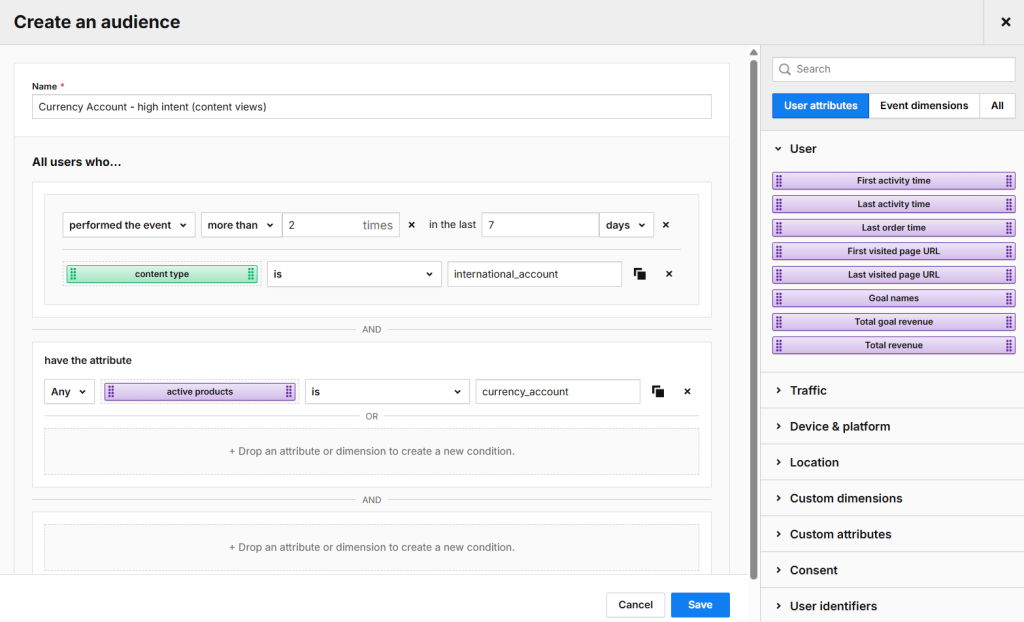
Create audience
Create an audience of logged-in users who visited content labeled international_account more than 2 times in the last 7 days and do not have active products called currency_account.
Activate & personalize
Activate this audience in In-app messaging/personalization and serve a contextual message after an FX-related action or on the account dashboard:
- Message: “Avoid exchange fees. Keep money in EUR or USD and pay abroad without repeated conversions.”
- CTA: “Open currency account”
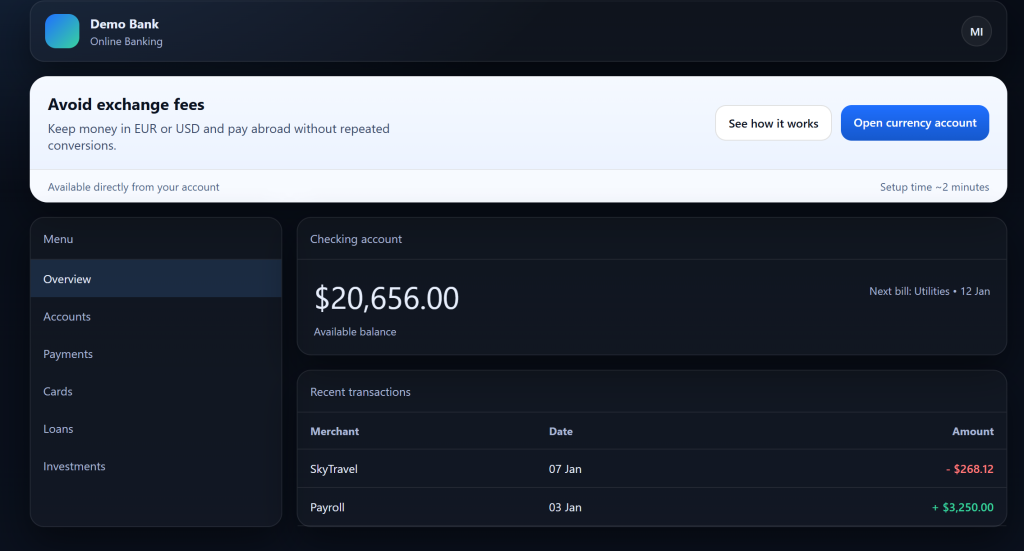
This ensures the message appears only when intent is clear and timing is relevant, maximizing conversions without over-messaging.
Moving forward with banking website optimization
Good banking website analytics doesn’t require you to compromise your customers’ trust. Use tools built for financial institutions, implement bank-specific privacy controls from the start, focus on metrics that drive real improvements, and create processes that turn visitor insights into site optimizations.
Your customers trust you with their money. Show them you also respect their data when they visit your website.
Ready to implement web analytics that ensures financial data security? Piwik PRO’s Analytics Suite is designed specifically for financial institutions, with built-in compliance controls, flexible data residency, and complete data ownership.
Frequently Asked Questions
What is banking website analytics?
Banking website analytics is the process of collecting and analyzing visitor data from bank and financial institution websites to understand customer behavior, optimize digital experiences, and improve conversion rates while maintaining strict privacy compliance with regulations like GLBA, GDPR, and PCI DSS.
Why can’t banks use Google Analytics for their websites?
Google Analytics shares customer data with third parties for advertising purposes, cannot guarantee data residency in specific locations, gets blocked by ad blockers on 25-40% of sessions, and lacks built-in privacy controls required by banking regulations. Banks need analytics platforms designed specifically for regulated industries and that provide complete data ownership.
What metrics should banks track on their websites?
Banks should track application completion rates by traffic source, drop-off points in multi-step forms, calculator and tool usage patterns, error rates by form field, page load times by device, cross-device journey behavior, and security indicators like bot traffic and unusual session patterns.
How do banks track website analytics without violating GLBA?
Banks can comply with GLBA by using server-side tracking that routes data through their own servers, automatically stripping PII before storage, implementing separate tracking for public pages versus authenticated portals, obtaining proper consent, setting aggressive data retention policies, and using analytics platforms that offer data residency control and business associate agreements.
What is server-side tracking for banking websites?
Server-side tracking routes website analytics data through the bank’s own servers instead of browser JavaScript. This approach bypasses ad blockers, provides complete visitor data, gives banks full control over what information gets collected, and ensures all data processing happens on bank-controlled infrastructure before reaching analytics databases.
How can banks track website visitors who don’t consent to analytics?
Banks can use anonymous tracking methods that collect behavioral data without personal identifiers. Piwik PRO offers anonymous tracking with session identifiers (lasting 30 minutes) that track page views, conversions, and behavior patterns during single sessions without identifying individuals across visits – enabling insights from 100% of traffic while respecting privacy preferences.
What’s the difference between tracking public banking pages versus online banking portals?
Public marketing pages need comprehensive behavioral analytics to optimize content and conversions. Authenticated online banking portals require minimal tracking focused on performance monitoring, error detection, and security, not behavioral tracking. This separation respects customers’ privacy when they are logged into sensitive banking functions.
How long should banks retain website analytics data?
Banks should retain standard behavioral analytics for 6-12 months, fraud detection patterns according to investigation policies (typically 1-2 years), compliance audit trails per regulatory requirements (often 5-7 years), and raw event data for shorter periods than aggregated reports. Automated deletion policies ensure consistent enforcement.
Can banking website analytics help prevent fraud?
Yes. Banking website analytics can detect bot traffic attempting credential stuffing, identify unusual traffic patterns indicating attacks, flag geographic anomalies (login attempts from impossible locations), monitor form completion speeds (bots complete forms in 2 seconds vs. 30+ for humans), and alert security teams to suspicious session behavior in real-time.
What is data residency, and why does it matter for banking analytics?
Data residency refers to the physical location where website analytics data is stored. Banking regulations often require customer data to remain in specific geographic regions. Privacy-first analytics platforms let banks choose exact storage locations (specific countries, regions, or private cloud servers) to meet regulatory requirements and demonstrate compliance with data localization laws.
How does anonymous tracking differ from regular website analytics?
Anonymous tracking collects website behavior without creating persistent user profiles. It uses temporary session identifiers (lasting 30 minutes) instead of long-term cookies, tracks page views and conversions without personal data, cannot identify returning visitors across sessions, and provides aggregate insights while respecting visitor privacy – particularly valuable for non-consenting visitors.
What’s the cost of not optimizing banking website analytics?
Poor banking website analytics leads to incomplete application funnels (where you lose 40-60% of applicants), wasted marketing spend on low-converting channels, missed mobile optimization opportunities (mobile visitors often convert at half the rate of desktop), inability to identify and fix technical errors affecting customers, and a competitive disadvantage as digitally-mature banks capture market share through superior online experiences.